
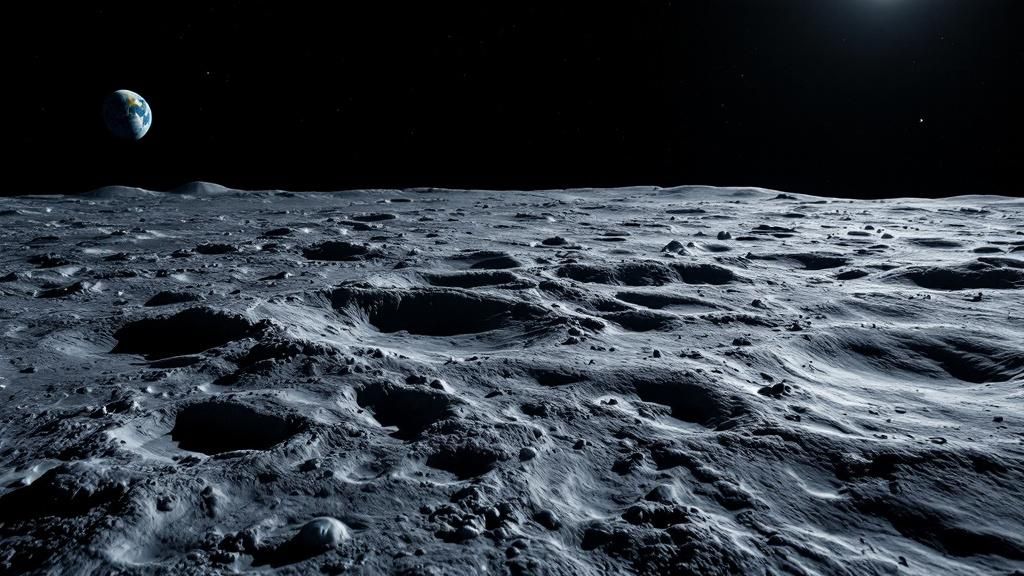
America is preparing to return to the Moon in a way it hasn’t done for over half a century. In the days ahead, the Nasa (Nasa) will launch the Artemis II mission, sending four astronauts on a journey around Earth’s nearest celestial neighbour. Whilst the 1960s and 1970s Apollo missions saw a dozen astronauts walk on the lunar surface, this fresh phase in space exploration brings different ambitions altogether. Rather than simply planting flags and gathering rocks, the modern Nasa lunar initiative is driven by the prospect of mining valuable resources, setting up a permanent Moon base, and ultimately using it as a stepping stone to Mars. The Artemis initiative, which has consumed an estimated $93 billion and engaged thousands of scientific and engineering professionals, represents the American response to growing global rivalry—particularly from China—to control the lunar frontier.
The elements that make the Moon worth returning to
Beneath the Moon’s barren, dust-covered surface lies a treasure trove of important substances that could reshape humanity’s approach to space exploration. Scientists have located numerous elements on the lunar terrain that mirror those present on Earth, including scarce materials that are growing rarer on our planet. These materials are essential for modern technology, from electronics to clean energy technologies. The abundance of materials in certain lunar regions makes harvesting resources commercially attractive, particularly if a permanent human presence can be set up to extract and process them productively.
Beyond rare earth elements, the Moon contains considerable reserves of metals such as iron and titanium, which might be employed for manufacturing and construction purposes on the lunar surface. Helium—a valuable resource—found in lunar soil, has numerous applications in medical and scientific equipment, such as cryogenic systems and superconductors. The prevalence of these materials has prompted space agencies and private companies to regard the Moon not simply as a destination for exploration, but as a potential economic asset. However, one resource proves to be considerably more vital to maintaining human existence and enabling long-term lunar habitation than any metal or mineral.
- Rare earth elements concentrated in designated moon zones
- Iron and titanium for structural and industrial applications
- Helium used in scientific instruments and medical apparatus
- Plentiful metallic resources and mineral concentrations across the lunar surface
Water: a critically important discovery
The most significant resource on the Moon is not a metal or uncommon element, but water. Scientists have found that water exists contained in certain lunar minerals and, most importantly, in significant amounts at the Moon’s polar areas. These polar regions contain perpetually shaded craters where temperatures remain intensely chilled, allowing water ice to build up and stay solid over millions of years. This discovery dramatically transformed how space agencies view lunar exploration, transforming the Moon from a lifeless scientific puzzle into a conceivably inhabitable environment.
Water’s importance to lunar exploration should not be underestimated. Beyond providing drinking water for astronauts, it can be split into hydrogen and oxygen through the electrolysis process, providing breathable air and rocket fuel for spacecraft. This feature would dramatically reduce the cost of space missions, as fuel would no longer need to be transported from Earth. A lunar base with access to water resources could become self-sufficient, supporting long-term human occupation and serving as a refuelling station for deep-space missions to Mars and beyond.
A new space race with China at its core
The initial race to the Moon was essentially about Cold War rivalry between the United States and the Soviet Union. That political rivalry drove the Apollo programme and resulted in American astronauts landing on the lunar surface in 1969. Today, however, the competitive landscape has shifted dramatically. China has emerged as the primary rival in humanity’s return to the Moon, and the stakes feel just as high as they did during the Space Race of the 1960s. China’s space agency has made remarkable strides in the past few years, successfully landing robotic missions and rovers on the lunar surface, and the country has officially declared ambitious plans to land humans on the Moon by 2030.
The reinvigorated urgency in America’s lunar ambitions cannot be disconnected from this competition with China. Both nations recognise that creating a foothold on the Moon holds not only scientific credibility but also strategic importance. The race is no longer just about being the first to set foot on the surface—that milestone was achieved over 50 years ago. Instead, it is about gaining access to the Moon’s resource-abundant regions and establishing territorial advantages that could influence space activities for decades to come. The competition has changed the Moon from a shared scientific frontier into a disputed territory where state interests collide.
| Country | Lunar ambitions |
|---|---|
| United States | Artemis II crewed mission; establish lunar base; secure polar water ice access |
| China | Land humans on the Moon by 2030; expand robotic exploration; build lunar infrastructure |
| Other nations | Contribute to international lunar exploration; develop commercial space capabilities |
Asserting lunar territory without ownership
There remains a peculiar legal ambiguity regarding lunar exploration. The Outer Space Treaty of 1967 stipulates that no nation can assert ownership of the Moon or its resources. However, this worldwide treaty does not prevent countries from securing operational authority over specific regions or obtaining exclusive rights to valuable areas. Both the United States and China are acutely conscious of this distinction, and their strategies reflect a resolve to secure and exploit the most resource-rich locations, particularly the polar regions where water ice accumulates.
The question of who manages which lunar territory could determine space exploration for generations. If one nation sets up a permanent base near the Moon’s south pole—where water ice accumulations are most prevalent—it would obtain enormous advantages in regard to resource harvesting and space operations. This prospect has heightened the importance of both American and Chinese lunar programmes. The Moon, previously considered as our collective scientific legacy, has emerged as a domain where strategic priorities demand quick decisions and tactical advantage.
The Moon as a stepping stone to Mars
Whilst securing lunar resources and creating territorial presence matter greatly, Nasa’s ambitions go well past our nearest celestial neighbour. The Moon serves as a vital proving ground for the systems and methods that will eventually transport people to Mars, a far more ambitious and demanding destination. By refining Moon-based operations—from landing systems to survival systems—Nasa gains invaluable experience that directly translates to interplanetary exploration. The lessons learned during Artemis missions will become critical for the long journey to the Red Planet, making the Moon not merely a destination in itself, but a vital preparation ground for humanity’s next major advancement.
Mars represents the ultimate prize in space exploration, yet reaching it demands mastering challenges that the Moon can help us understand. The harsh Martian environment, with its sparse air and vast distances, requires durable systems and proven procedures. By setting up bases on the Moon and conducting extended missions on the Moon, astronauts and engineers will acquire the expertise necessary for Mars operations. Furthermore, the Moon’s proximity allows for relatively rapid troubleshooting and supply operations, whereas Mars expeditions will require extended voyages with limited support options. Thus, Nasa regards the Artemis programme as a crucial foundation, converting the Moon to a development ground for deeper space exploration.
- Evaluating life support systems in the Moon’s environment before Mars missions
- Developing advanced habitats and equipment for extended-duration space operations
- Preparing astronauts in extreme conditions and emergency procedures safely
- Perfecting resource utilisation methods suited to remote planetary settlements
Assessing technology in a safer environment
The Moon offers a significant edge over Mars: closeness and ease of access. If something malfunctions during operations on the Moon, emergency and supply missions can be deployed in reasonable time. This safety buffer allows engineers and astronauts to test innovative systems and methods without the catastrophic risks that would accompany equivalent mishaps on Mars. The two-to-three-day journey to the Moon establishes a controlled experimental space where advancements can be thoroughly validated before being deployed for the six-to-nine-month journey to Mars. This incremental approach to space exploration embodies sound engineering practice and risk management.
Additionally, the lunar environment itself presents conditions that closely mirror Martian challenges—exposure to radiation, isolation, extreme temperatures and the requirement of self-sufficiency. By conducting long-duration missions on the Moon, Nasa can assess how astronauts operate mentally and physically during extended periods away from Earth. Equipment can be tested under stress in conditions remarkably similar to those on Mars, without the extra complexity of interplanetary distance. This methodical progression from Moon to Mars represents a practical approach, allowing humanity to establish proficiency and confidence before pursuing the substantially more demanding Martian mission.
Scientific discovery and inspiring future generations
Beyond the key factors of resource extraction and technological advancement, the Artemis programme holds significant scientific importance. The Moon functions as a geological record, preserving a record of the early solar system largely unchanged by the erosion and geological processes that continually transform Earth’s surface. By collecting samples from the Moon’s surface layer and examining rock formations, scientists can unlock secrets about how planets formed, the meteorite impact history and the conditions that existed in the distant past. This research effort complements the programme’s strategic goals, offering researchers an unique chance to broaden our knowledge of our cosmic neighbourhood.
The missions also seize the imagination of the public in ways that purely robotic exploration cannot. Seeing astronauts traversing the lunar surface, performing experiments and establishing a sustained presence resonates deeply with people across the globe. The Artemis programme serves as a tangible symbol of human ambition and capability, inspiring young people to pursue careers in science, technology, engineering and mathematics. This inspirational dimension, though challenging to measure in economic terms, constitutes an invaluable investment in humanity’s future, cultivating wonder and curiosity about the cosmos.
Uncovering vast stretches of planetary history
The Moon’s primordial surface has stayed largely unchanged for eons, creating an exceptional scientific laboratory. Unlike Earth, where geological processes continually transform the crust, the Moon’s surface retains evidence of the solar system’s violent early history. Samples gathered during Artemis missions will expose details about the Late Heavy Bombardment, solar wind effects and the Moon’s internal structure. These discoveries will fundamentally enhance our understanding of planetary development and habitability, offering essential perspective for comprehending how Earth developed conditions for life.
The wider impact of space exploration
Space exploration programmes produce technological advances that permeate everyday life. Technologies created for Artemis—from materials science to medical monitoring systems—frequently find applications in terrestrial industries. The programme drives investment in education and research institutions, stimulating economic growth in high-technology sectors. Moreover, the collaborative nature of modern space exploration, involving international partnerships and shared scientific goals, demonstrates humanity’s capacity for cooperation on ambitious projects that go beyond national boundaries and political divisions.
The Artemis programme ultimately embodies more than a lunar return; it embodies humanity’s sustained passion to investigate, learn and progress beyond existing constraints. By developing permanent lunar operations, advancing Mars-bound technologies and engaging the next wave of scientific and engineering professionals, the initiative tackles several goals simultaneously. Whether measured in scientific discoveries, technical innovations or the immeasurable worth of human achievement, the investment in space exploration continues to yield returns that reach well beyond the lunar surface.
